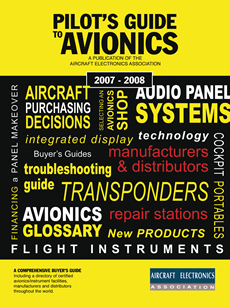
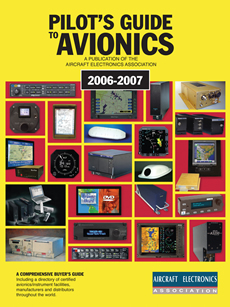
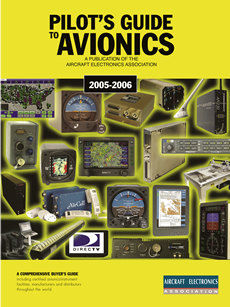
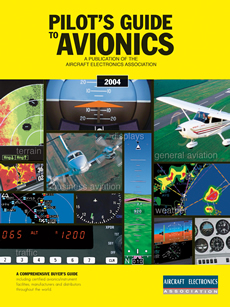
2012-13Pilot's Guide to Avionics
View Entire Digital Edition
2011-12Pilot's Guide to Avionics
View Entire Digital Edition
2010-11Pilot's Guide to Avionics
View Archive [+]
From the Publisher
by Paula Derks, AEA president read now)
New Products for 2010
by Christine Knauer read now)
Wi-Fi in the Sky
by Joseph E. (Jeb) Burnside(read now)
Hand-Held GPS
by Dale Higdon (read now)
Weather Information in the Cockpit
by Dale Smith read now)
Before & After
by AEA Staff
(read now)
Part 145 Avionics Shops
by AEA Staff(read now)
Buyer's Guide: Adapting ADS-B
by Dave Higdon read now)
Keeping Up With Your Boxes
by Dave Higdon(read now)
Let George Do It
by Dave Higdon(read now)
Electrifying Owners
by Dave Higdon(read now)
2009-10Pilot's Guide to Avionics
View Archive [+]
Your Glass Panel Future: Strategies for Selecting a Glass-Panel Retrofit
by Paul NovacekIn this information age, we have been led to believe more data is good, but this is not necessarily the case. Often more is not better; it’s just more. Bits and pieces of data are meaningless unless the data is integrated into information. (more)
New Products -
Pack Big Value, Options, Flexibility
by Christine KnauerIn 2009, the avionics industry enjoyed a wave of new products that offer Wi-Fi capability, Internet access, interactive touch-screens, and iPod connectivity. For the cockpit, companies rolled out localizer performance with vertical guidance (LPV) solutions as well as easy retrofits with more capabilities and more value. From glass instrumentation for smaller aircraft to all-in-one communications boxes, most new products underscored the importance of affordable pricing and extended features. (more)
What You Should Know About
Buying Pre-Owned Avionics
by Dale SmithLet’s say you want to put a new Garmin GNS 530 with WAAS in your airplane. Buying it from a reputable avionics shop would cost around $15,000. But what if you could buy a “preowned” GNS 530W online for under $9,000? You might think it’s too good of a deal to pass up. Or is it? (more)
Quantity & Consumption -
The Building Blocks of Fuel-Management Systems
by Scott M. SpanglerPilots have been flying their airplanes out of gas ever since the Wright brothers first put wings on a powerplant. Then, as now, it makes the news.
Datelined March 18, 1906, The New York Times, under the headline “Aero Club Honors the Wright Brothers,” reported one of the earliest incidents: Talking about the success of the Flyer III, the article said, “With this improved machine, six notable flights were made between Sept. 26 and Oct. 5 (1905). That of Oct. 5 was the most successful, for the machine remained in the air 38 minutes and 3 seconds and traveled a distance of 24 1/5 miles. Exhausting of fuel was the cause of stopping.”
(more)
Envisioning What Lies Ahead - Synthetic and Enhanced Vision
Point the Way to the Future
by James WynbrandtVisionaries always lead the way to the future, and perhaps nowhere more so than in today’s aircraft cockpits where synthetic vision systems (SVS) and enhanced vision systems (EVS) are showing pilots the path to tomorrow. With their ability to reveal what lies ahead in any weather or light condition, SVS and EVS dramatically improve situational awareness and safety in all phases of operation — ground and air. (more)
A Buyer’s Guide: ELTs
by Paul NovacekThe simple acronym ELT is short for emergency locator transmitter. These little orange or yellow boxes tucked back in the tail of your airplane are designed to give you and your passengers a fighting chance if things go horribly wrong. (more)
What Makes an
AEA Member Shop Special?
by Gary PicouYou don’t want just anyone working on your airplane, right? You want the most capable and meticulous hands on your machine, as if your life depends on it. So, how do you find those gifted and qualified hands? (more)
A Buyer’s Guide: Standalone Instruments
by Dave Higdon
Most pilots remember significant
events in their
flying lives: their first solo;
their first cross-country flight;
check rides; and flights significant
because they don’t fit the desirable
description of “uneventful.” (more)Digital Simplicity:
Basic Hardware
Meets All
Flying Needs
by Scott M. SpanglerDuring aviation’s just-ended analog era, choosing the right avionics system for your airplane was not unlike assembling a stereo system in the 1970s, with each component, a tuner, turntable and tape decks (open reel and those newfangled cassettes) embodied in a bulky expensive box. In the living room or the cockpit, it was a paradox of wants and needs constrained by space and available funds. (more)
2008-09Pilot's Guide to Avionics
View Archive [+]
New Products Pilots and Their Aircraft
by Christine KnauerAirborne telecommunications, WAAS-enabled GPS and flight display systems dominated the Aircraft Electronics Association’s 2008 International Convention & Trade Show in Washington, D.C., early this year. Other products — from in-flight high-definition video to a tiny altitude encoder — made big news, too. (more)
A Buyer's Guide: Multi-Function Displays
by Dave HigdonMany a skeptic has expressed his doubts by uttering one succinct phrase: “Seeing is believing.” The comment leaves room for him to be convinced — if he is shown. (more)
A Buyer's Guide: Weather Detection & Avoidance
by Dave HigdonMany a good story starts with the phrase, “Once upon a time…” So it is with how pilots obtain weather information to inform their flight planning and mission decisions. (more)
Upgrading to the World of WAAS
by Scott M. SpanglerWith all due respect to the centennial anniversary of the Wright brothers’ first flight, the second century of powered flight really began at 1201 EDT on July 10, 2003. That’s when the FAA turned on the wide area augmentation system — WAAS for short.
(more)
ADS-B In(side) and Out
by James WynbrandtIt is the foundation of the FAA’s NextGen Air Traffic Control system. Automatic dependent surveillance–broadcast (ADS-B) will enable safer, more efficient use of the National Airspace (NAS) while offering an array of ancillary services: traffic alerts, terrain avoidance, realtime graphical weather displays and text messaging. (more)
Communicating Your Needs and Expectations to Your Avionics Shop Before an Installation
by Greg LasloWhen it comes to your avionics installation, you to need to communicate clearly to, well, communicate clearly. This goes for aviating and navigating, too. (more)
A Pragmatic Approach to Buying Avionics
by Scott M. SpanglerFor more than a decade, pilots have been forming clots in the aisles of exhibitors at EAA AirVenture in Oshkosh, Wis., learning about and comparing the latest avionics. Those with portable needs go home immediately satisfied. Those with panel-mounted or remote needs should follow a more premeditated path because surrendering to impulse often is expensive. (more)
2007-08Pilot's Guide to Avionics
View Archive [+]
New Products Pilots and Owners Will Want
by Dale Smith
Whether flying a light-sport aircraft or a Falcon
X, most pilots share one thing in common: the love of all things
new. Which is the reason single-engine airplanes rarely are
flown beyond the range of a $100 (now $150) hamburger but still
are loaded with the latest avionics. The owner just had to have
it — all of it. (more)
Audio Panel Systems Buyer's Guide
by Paul Novacek
The audio panel is a pilot’s interface link
to all that is sound. It’s a central point of communications
control, both to the external world and fellow crew or passengers.
The old days had pilots flipping switches scattered around the
panel and yelling to fellow crew who were only a foot away.
(more)
Cockpit Portables: Becoming an Informed
Buyer
by Joseph E. (Jeb) BurnsideWhen aircraft owners consider an avionics upgrade, they usually think in terms of installing new panel- and/or remote-mounted equipment. That’s as it should be: The reliability and accuracy of an FAA-approved avionics installation not only enhances an aircraft’s utility, it can transform it from a local-only flier into a crosscountry traveling machine, capable of dealing with most weather and airspace. (more)
Flight Instruments: They Deserve Attention
by Joseph E. (Jeb) BurnsideNo matter how old or new your aircraft is, you’re probably staring at a few examples of something called a “flight instrument” when you fly. Even if you’re lucky enough to be in a certified aircraft with a glass panel displaying computer-generated versions of conventional gauges, you still have a set of backup instruments to help get you home if all the “magic” fails. (more)
The Glass Menagerie: Getting Comfortable
with Integrated Display Technology
by James WynbrandtLike a modern Cinderella story, general aviation aircraft panels are going from dowdy to dazzling thanks to glass — not glass slippers, but glass-display technology.
“We’re starting to see glass everywhere,” said Jessica Myers, spokesperson for Garmin International, the Olathe, Kan.- based avionics manufacturer. “Now, there’s a way for everybody who wants a glass cockpit to get one.” (more)
What Role Should Avionics Play in Your
Aircraft Purchasing Decision?
by Dale SmithCongratulations! You’re finally going to achieve every pilot’s dream: buying your own airplane. Choosing which model, type and year to buy is the fun part, so we won’t interfere with those decisions. However, when you start to get serious about a particular airplane, there are three major elements to consider when deciding if it’s a “deal or no deal.” (more)
Financing a Panel Makeover
by Dave HigdonIf you’re like many pilots, you find yourself frustrated by the gap between the panel you want and your ability to pay the tab.
Of course, one guaranteed way to the panel of your dreams is to swap that old airplane for a new — or newer — one. But if you love the plane you’re with, a panel makeover can close the gap for far fewer funds than the cost of new wings, and it can give you equal — or near-equal — performance to a new bird. (more)
10 Questions to Ask Before Selecting
an Avionics Shop
by Dave HigdonDifferent consumers act, well, differently — there’s little doubt about that. Where one might comparison shop looking for every penny of advantage, some show only casual interest in the most common question: How much?
But even price-centric buyers often fail to ask other questions with the potential for importance equal to or greater than the dollar signs on the invoice. (more)
Avionics Looking Forward...Far, Far Forward
by Gary PicouIn this 50th year of the Aircraft Electronics Association, it’s natural to pause and look back to see where we came from. It’s also fun to look forward — trying to imagine what the next 25 years might bring.
In this article, we let imagination take flight as we piece together the past progress, current research and future possibilities. (more)
Transponders Buyer's Guide
by Paul NovacekThe venerable transponder originally was developed in the 1940s for the wartime need of identifying friendly aircraft from adversaries. Then called an IFF (identify friend or foe), the transponder has evolved into a vital part of our air traffic control system. Without transponders, ground controllers wouldn’t know where anyone was, and the chaos soon would result in aluminum rain. (more)
2006-07Pilot's Guide to Avionics
View Archive [+]
Hot New Avionics Offerings for 2006
by Dale SmithTo paraphrase a popular saying from the 1970s — “Avionics is where the action is.” Just look at most of the “new” airplanes introduced recently. If it has a propeller on it, chances are all the advancements are found in the instrument panel.In fact, the marketing and sales people at Beechcraft, Cessna, Mooney and Piper should be sending the folks at Avidyne, Garmin and other manufacturers thank-you cards. While the airframe OEMs and their avionics partners certainly have brought new life into factory-new airplanes, there’s also plenty of activity in the after-market segments. (more)
In-Flight Entertainment Systems - Buyer's Guide
by Paul NovacekThe takeoff and landing is always exciting, but with the global-reaching range of the latest corporate jets, there’s plen-ty of time between those takeoffs and landings. So, step into the world of in-flight entertainment systems, or IFE. A growth out of music players of long past, the current offerings rival any home theater.An in-flight entertainment system contains three basic functions: audio, video and flight data. Some would argue an air-borne office constitutes entertain-ment, but for the purposes of this comparison, let’s stick to the big three forms of traditional “entertainment.” (more)
The Brains Behind Glass Cockpit Beauty
by Gary PicouToday’s avionics are marvels of technology, integration, application and innovation. They bring safety and conve-nience to the pilot in new ways, while maintaining a consistent structure that is recognizable to any pilot with a few hours under his belt.This entire slick human inter-face, which often looks like a Microsoft flight simulator, didn’t just happen. All of this technology has taken years of work, study, research and development. So, what happens behind the panel — from design to signals in space — that allows pilots to fly behind a glass panel? (more)
Cabin Connectivity: Getting Connected to High-Speed Data
by Dale SmithTurn back the clock some 25 or so years and the battle cry of the American teen-ager was, “I want my MTV!” Now, those same people have gradu-ated off their parents’ couches and into the cabins of their companies' business jets, and they’ve changed their collective mantra to: “I want my high-speed data connection.” Just look at the proliferation of Wi-Fi “hotspots.” Heck, you can even get “connected” at McDonald’s. (more)
Why You Need an Engine Monitor
by Joseph E. (Jeb) BurnsideFor most operators, engines remain the most expensive and complicated single com-ponent in an aircraft. Even the smallest uncertified two-cylinder engine powering an ultralight is made from a dizzying array of parts that must work and play well together for hours at a time — then they sit around, unused, for days or weeks. (more)
Got IFDs? Integrated Flight Decks
by Dale SmithWhere once they were found only in the top-end air transport aircraft, today they are found in the panels of nearly every new aircraft type. In fact, it would be difficult to find a production airplane that doesn’t have them — “them” being integrated flight decks, or IFDs. The more familiar marketing monikers include G1000, Entegra, Pro Line 21 and EPIC.What exactly are IFDs? There is still a bit of uncertainty among aircraft owners as to what constitutes a “real” integrated flight deck from a “nearly” integrated flight display. (more)
ADS-B: A Datalink for Everyone
by Julie K. BoatmanImagine climbing into your single-engine airplane, starting up, then turning on the avionics master. As the boxes begin warming up, a stream of information pours onto a screen the size of a CD jewel box. You enter your flight plan and zoom out the display on the map page to see weather along the route. A green dot marks your destination and you smile — you’re good to go, the ceiling and visibility indicate good VFR conditions. (more)
Retrofit Autopilot Systems - Buyers Guide
by Paul NovacekA Little History
It all began with an invention developed by Elmer Sperry in the early 1900s — the gyroscope. This device uses a spinning mass that keeps its orientation while an airplane moves around it, which is the basic principle underlying today’s artificial horizon gyro. Originally designed to help ships steer a steady course, Elmer’s son, Lawrence Sperry, used his father’s invention to successfully launch an aircraft company specializing in aircraft control systems. Along the way, the Lawrence Sperry Aircraft Co. built the Messenger airplane and gyro-based instruments that are still in use today. Sperry began experiments in the early 1920s using gyros to sense attitude and using motors to drive the controls, resulting in the precursor of the modern-day autopilot. (more)
What is the Future of Traffic Advisory Systems?
by Ric PeriDiscussions about the shut-down of traffic information systems at various sites around the country have created quite a stir, and many pilots have questions, such as: What traffic advisory systems are available to light general aviation aircraft? What are the differences in the systems? And where are the 23 sites projected to be shut down?Traffic information service (TIS), automatic dependent surveillance-broadcast (ADS-B) and traffic information service-broad-cast (TIS-B) all provide traffic advisory information. (more)
2005-06Pilot's Guide to Avionics
View Archive [+]
Factors Affecting Your Avionics Buying Decisions
by Dale SmithPick up any aviation magazine—including this very Pilot’s Guide—and you're going to see all kinds of ads for all kinds of really cool new avionics units. Radios, GPSs, TCAS, TAWS, datalinked systems, MFDs, radar—the list goes on and on. And isn't window-shopping for your dream panel part of the fun of owning your own airplane? You bet! (more)
Datalink Hits Critical Mass Weather, traffic and other data in the cockpit
by Julie BoatmanIs datalink the new GPS?
In 10 years will we have forgotten how to read a traditional weather synopsis or radar summary chart in favor of jazzy super-Nexrad graphics pumped directly to our flight management systems? Will the average Cessna 172 or Piper Warrior have a traffic display with targets courtesy of air traffic control? (more)
FAA “Taxes” General Aviation,
The cost of safety is not always obvious
by Gary PicouIn case you hadn't heard, the world of corporate jet operators was set on its collective ear last year as they rushed to comply with the FAA's mandate stating that they be equipped with ELTs by January of 2004. It caused quite a problem for operators who waited too long to do the required installations. The suppliers couldn't keep up with demand. (more)
FAA/Industry Training Standards
FITS and the Future of General Aviation
Training
by Michael W. BrownFlight training within the general aviation (GA) com-munity has reached a criti-cal juncture. While the industry as a whole enjoys an admirable safety record, the proliferation of advanced technologies in small aircraft cockpits, coupled with their increased performance capabilities, has led the Federal Aviation Administration (FAA) to take a critical look at how pilots are trained. (more)
Avionics for International Operations
by Joseph E. (Jeb) BurnsideMost pilots and aircraft owners have considered flying to international destinations at least once in their aviation careers. Canada, Mexico and various Caribbean islands are popular international destinations for U.S. pilots, and these “foreign” countries see a lot of N-registered aircraft coming and going. (more)
Maintenance for Experimental and Light Sport Aircraft
by Ric PeriFor years I have heard the argument made by the experimenters that their aircraft are experimental and outside of the Federal Aviation Regulations and, therefore, don't need the services of avionics professionals. Well, with the introduction of the Light Sport Aircraft (LSA) Rule and the growth of the experimental aircraft marketplace, perhaps a review of the FARs might be in order. (more)
What’s New in Avionics 2005
by Dale SmithOne of the toughest questions for any pilot to answer is which avionics they should get for their We pilots are a curious lot. No matter what we have we've always got our eyes open for something different. Maybe it's bigger or faster or newer. But no matter the reason, we're all always looking for “what's next.” And in the rapidly changing world of avionics and aircraft electronics that can be a daunting task. (more)
Sport Pilot, LSA, and The Burgeoning Sport Aviation Market
Compiled By Staff Of The AERO-NEWS NetworkThere's an old corollary running around the aviation world that compares the creation of new aviation programs and associated regulations with the birthing of an elephant... In other words, they both take forever to accomplish, can't happen without a lot of yelling/screaming/noise, and tend to take on monstrous proportions as time passes. (more)
Terrain Awareness and Warning Systems—TAWS Buyer’s Guide
by Paul NovacekControlled Flight Into Terrain (CFIT) describes an accident where a completely airworthy aircraft is flown into the terrain. These accidents only occur during poor visual conditions; but other factors besides visibility usually contribute, such as a cockpit distraction, malfunctioning equipment, an ATC error or a pilot/controller miscommunication. To reduce the occurrence of Controlled Flight Into Terrain accidents, Terrain Awareness and Warning Systems (TAWS) were developed to provide a warning of a possible terrain conflict. The purpose of a TAWS is to provide a warning with enough time for the flight crew to take appropriate action. (more)
Traffic Alert Collision Avoidance Systems—TCAS Buyer’s Guide
by Dale SmithI can tell you from personal experience that it only takes one alert from your traffic advisory system to make you never want to fly without it again. Having that extra set of electronic eyes that can see “traffic” above, behind, below you, through haze, precipitation, clouds, darkness—you name it, is something no pilot should ever want to leave home without. (more)
2004Pilot's Guide to Avionics
View Archive [+]
New Avionics & Equipment Round Up; All the stuff you just gotta' have
by Dale SmithEvery year, general aviation avionics manufactures and installers meet at the Aircraft Electronics Association's Annual Convention and Trade Show to trade ideas and show off the new stuff. At the most recent convention, many manufacturers introduced extra slick advanced avionics that will soon be the hottest things on the market. Others introduced new services they offer. This covers the latest technology that you'll want in your cockpit. (more)
Weather the Weather; Datalink, sferics and radar for the light aircraft pilot
by Julie BoatmanThe best forecast is still just a prediction-an educated one, but a prediction nonetheless. We know that the only weather we can count on is the weather we see out the window. And from the windows of our cockpits, what we see isn't always the big picture. Enter weather products for the cockpit. (more)
Avionics for your Homebuilt and Sport Aircraft
by James WynbrandtBuilding or buying a high performance kit aircraft? If so, you're probably planning on installing an equally sophisticated panel to match. Avionics professionals say most of the homebuilt panels they're helping fashion today feature gear like MFDs (multi-function displays), IFR-certified GPS units, real-time weather display capability and more. (more)
From MFD to PFD--Displays for Your Cockpit
by George WilhelmsenThe options to install a display in your cockpit have literally exploded in recent years. Text and monochrome moving maps have given way to equipment that can display position and its relation to various features and hazards in living color. Multi-function and primary flight displays have been developed to help pilots improve situation awareness, avoid hazards, to provide primary flight guidance, and reduce cockpit workload. (more)
Compliance Countdown
by Gordon GilbertReprinted with permission from Aviation International News. This cronicles mandated regulatory issues from the FAA that deal with general aviation and commercial aircraft. (more)
Finding the Right Combination of Avionics for Your Panel
by George WilhelmsenOne of the toughest questions for any pilot to answer is which avionics they should get for their instrument panel. After all, there is a virtual plethora of avionics available, each with its own associated features to choose from. With the dizzying array of products and features that are available, more than one pilot has been left trying to figure out which avionics they should buy for their panel. (more)
TAWS FAA mandates a new proximity to safety!
by Gary PicouSometimes a government mandate seems like bureaucratic meddling. Yet in the case of Terrain Awareness Warning System (TAWS) the mandate makes sense. It very well can save your life. The only airplanes that won't benefit from TAWS are those that never, ever fly with reduced visibility, over an unobstructed flat surface. The ocean is all that might qualify, as long as you don't go near oil rigs. (more)
Livin' and Flyin' with Old Time Radios
by Dale SmithNEWS FLASH–Oshkosh, Wis., July 2004, tens of thousands of pilots discover that they don't need a $15,000 full-color multifunction COMM/NAV/GPS to safely fly from Point A to Point B…Well, OK, so it's not really a news flash. But when you flip through all the popular aviation magazines you'll probably get the idea that if it doesn't have a "Direct To" button, it has got to go. (more)
Avionics: Enhancing Situational Awareness Via Integration
by Paul NovacekIn this information age we have been falsely led to believe that more data is good, but it's not necessarily so. Often more is not better, just more. Bits and pieces of data are meaningless unless the data is integrated into information, and that's the key, integration. (more)
Avionics with a Past---and a Future; Buying Used Equipment
by James WynbrandtPre-owned avionics and panelware can be an excellent value and help buyers significantly reduce equipment costs. They can also leave purchasers with a stack of defective or outdated merchandise that ends up costing them more in the long run than new equip-ment. Considering the potential risks and rewards, there are a few basics anyone considering tapping the pre-owned market needs to know. (more)
2003Pilot's Guide to Avionics
View Archive [+]
New Avionics:
Thirty Companies Reveal Their Latest Magic
by Gary PicouEvery year, general aviation avionics manufactures and installers meet at the Aircraft Electronics Association's Annual Convention and Trade Show to trade ideas and show off the new stuff. At the most recent convention, many manufacturers introduced extra slick advanced avionics that will soon be the hottest things on the market. Others introduced new services they offer. This covers the latest technology that you'll want in your cockpit. (more)
Compliance Countdown
Gordon Gilbert of Aviation International News compiled this list of upcoming compliance
deadlines on mandated avionics systems that you need to know about. (more)
What's New With Electronic Flight Bags?
by Dale SmithToday's Electronic Flight Bags (EFBs) have come a long way in a very short time. Sure they give you instant access to electronic versions of your approach plates and virtually eliminate paper from your cockpit
but they can do a whole lot more. But does every pilot need one? (more)
What's On Your Horizon?
Equipment Descriptions to Assist with Your Avionics Purchases
To help you in your avionics purchases, we've compiled detailed descriptions that
cover Navigation Equipment, Communication, Autoflight, In-Flight Entertainment,
Displays and Surveillance. (more)
Equipment Descriptions to Assist with Your Avionics Purchases
How to Choose a Headset
by George WilhelmsenWhen pilots first start to learn to fly, they frequently are interested in buying a set of headsets. Apart from the fact that they are more comfortable than earplugs, headsets provide better communications in the cockpit, which enhances the safety of flight and reduces the learning curve for new pilots. This article provides you with the information you need to make the right decision from the wide array of features that are available in headsets today. (more)
Safeguarding Your Avionics
The AEA Avionics Advisory Board has put together some helpful tips on maintaining your avionics
investment and protecting your valuable radios. (more)
Next Generation Avionics Dealing With Data
by Gary PicouThe next generation of avionics will make the traditional way of getting your clearances look like a quill pen inkwell. Just as the internet has dramatically increased the accessibility of information to the home, a datalink established from the ground to the cockpit will have a similar impact on aviation. Aviation safety will be beneficiary, along with less stress ("what'd he say, what'd he say??") and more accuracy. As consumers, aircraft owners are going to be faced with a confusing array of choices, including services, service providers, system types, and data transfer protocols. (more)
What Is a TSOA?
by Jason DicksteinThe acronyms TSO and TSOA are quite common in the avionics industry. They are used so commonly that we sometimes forget that those new to the industry (and even some who are long-time industry professionals) do not know what a TSO is. Find out what it is and how it affects you. (more)
Maintaining a Good Relationship Between the Avionics Shop and the Customer
Find out what information you need to provide your avionics shop to ensure a professional
installation at a reasonable cost, and, in turn, what you can expect from your avionics shop. (more)
TRAINING: The Key to Getting the Most Out of Your Avionics Investment
by Paul NovacekWhen making a purchase decision about your avionics, have you considered the training? No matter what the brochures say about how easy it is to use, you still need to learn the controls and what the displays are attempting to tell you. Good training material or time with a competent flight instructor costs money, but the reward allows you to gain the most out of your new avionics investment. (more)
The Best Way to Save Money on Your Avionics
Save money by avoiding these common errors when purchasing avionics. Eastern Avionics
International Inc. authors this informative article. (more)
Why Should You Use a DER?
by Greg WilsonWith technology expanding at an exponential rate, never before has the pilot had available so many options regarding aircraft alterations. These options often bring with them a more complex decision-making process involving critical time lines and financial considerations. As a pilot, and an FAA Designated Engineering Representative (DER), Greg Wilson is continually monitoring the avionics marketplace to stay in touch with what is happening with the development of new avionics systems and to stay current with regulatory requirements.
In-Flight Entertainment Systems
by Dale SmithWouldn't it be nice to pass the hours with a little background music? There's a seemingly endless assortment of ways to deliver your favorite music and even movies into your airplane in the highest fidelity imaginable. (more)